


Daniel Knitter: “Con 500 bar cargamos 45 kilos en 25 minutos: Düsseldorf marca el nuevo estándar del hidrógeno en Europa”
Daniel Knitter: “Con 500 bar cargamos 45 kilos en 25 minutos: Düsseldorf marca el nuevo estándar del hidrógeno en Europa”
Por Grace Keller
Fecha publicada: 26 Agosto, 2025

Europa dio un salto concreto en infraestructura para flotas: H2 MOBILITY, junto a Stadtwerke Düsseldorf y Rheinbahn, puso en marcha una estación de repostaje capaz de dispensar hasta 5 toneladas diarias de H₂ y atender en paralelo a tres vehículos.
La moderna estación —instalada en la calle Höherweg en Düsseldorf, Alemania— incorpora dispensadores para 350, 500 y 700 bar, un desempeño que supera ampliamente a la primera generación de estaciones alemanas y que está orientado a los ciclos exigentes del transporte público y la logística. Desde su apertura, quedó posicionada como la más grande de Europa y, además es la primera estación pública que ofrece 500 bar como nivel intermedio —un “world first”—, pensado para utilitarios y flotas que requieren más kilos por sesión que a 350 bar, sin asumir el mayor costo de equipamiento y compresión de 700 bar.
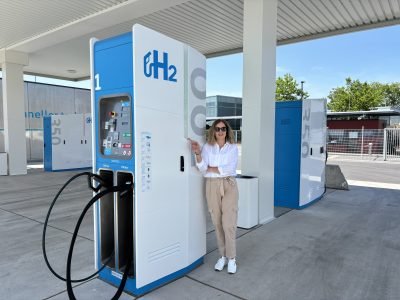 Durante una visita en julio, H2News accedió de forma exclusiva al detalle operativo y conversó en terreno con Daniel Knitter, gerente de Operaciones, quien explicó por qué la estación se diseñó pensando ante todo en ciclos intensivos de buses y camiones, y cómo el “500 bar” ordena la ecuación de costos, tiempos y disponibilidad. “Primero toma 500 bar; te garantizamos 40–45 kg en 20–25 minutos y ya estás de vuelta en ruta. Intentar lo mismo en 700 bar exigiría equipos mucho más grandes y encarecería el kilo de H₂”, explicó Knitter frente a los racks de compresión.
El abastecimiento ya es renovable (RFNBO certificado) y en 2026 la estación se conectará a un electrolizador de 2 MW ubicado justo detrás del recinto, propiedad de Stadtwerke Düsseldorf, alimentado con energía proveniente de la fracción biogénica de su planta de valorización de residuos. Con ello se acorta la logística y se reduce la huella de la cadena de suministro.
Claves técnicas
La instalación combina tres presiones (350/500/700 bar) en una misma isla, con tecnología de alto desempeño que mantiene caudal y presión para tres cargas simultáneas —buses, camiones, autos y vehículos comerciales ligeros—. En términos operativos, eso significa más turnos cumplidos, menos colas y una estación pensada para “pico y pala” de flotas, no solo para autos particulares.
Rheinbahn ya opera 20 buses de hidrógeno y sitúa esta estación —a minutos del depósito de Lierenfeld— como infraestructura crítica para asegurar ruta y disponibilidad. En paralelo, el mercado alemán se está moviendo: en marzo de 2025 la venta a 350 bar superó por primera vez a la de 700 bar en la red de H2 MOBILITY, señal del viraje hacia vehículos comerciales. Esa misma estrategia explica la consolidación de 22 estaciones pequeñas de 700 bar enfocadas en autos, al tiempo que se abren hubs de alto desempeño como el de Düsseldorf.
Por qué 500 bar importa
En terreno, la explicación de Knitter fue directa: 500 bar permite cargar del orden de 40–45 kg en 20–25 minutos y volver a ruta con rapidez. Intentar esa misma masa a 700 bar dispara el tamaño (y costo) de compresores y bancos de almacenamiento, encareciendo el kilo de H₂. De allí que 500 bar se haya incorporado como solución intermedia para utilitarios y futuras aplicaciones que requieran más kilos por sesión, sin “pagar” la complejidad de 700 bar.
Entrevista
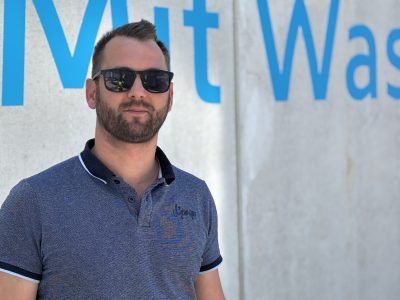 Señor Knitter, ¿Cuál es el dato duro que justifica llamar a esta estación la más potente de Europa?
La capacidad de hasta 5 t/día y la posibilidad de repostar tres vehículos a la vez (350/500/700 bar). Es un salto de escala respecto a las primeras estaciones del país.
¿Qué aporta 500 bar que no den 350 o 700?
Costo-eficiencia y ritmo operativo. A 500 bar cargamos 40–45 kg en 20–25 minutos, ideal para utilitarios y flotas que necesitan más masa por sesión sin la complejidad de 700 bar. 350 bar queda para buses y camiones; 700 bar, para autos y comerciales ligeros.
¿Cómo se sostiene ese rendimiento a lo largo del día?
Con almacenamiento intermedio y arquitectura modular. La operación describe tanques de ~1,2 t y dos tanques en ciclo para reponer la estación y acercarse al máximo diario cuando la demanda lo requiere. La clave, no obstante, es la compresión de alto desempeño y la gestión simultánea de presiones.
¿Y la regulación? ¿Se “homologa” como cualquier estación?
Sí. No se puede montar una HRS sin permisos. Hay licencias y exigencias claras (protección contra incendios, seguridad de proceso, metrología). “Está bien regulado; no es algo en camino, ya existe”, nos precisaron durante la visita.
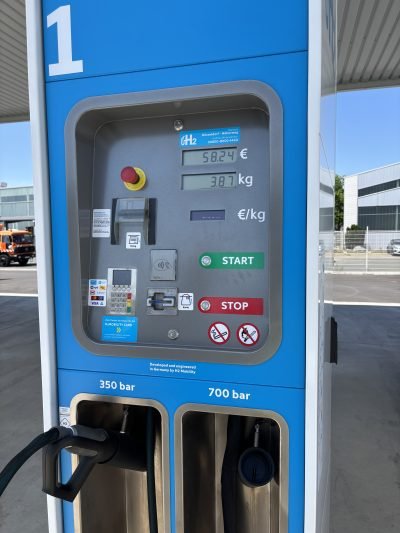 Durante la visita, el precio visible para 350 bar fue de 15,5 €/kg (valor mostrado en la app del operador en esa jornada; puede variar por contrato y presión).
El giro de H2 MOBILITY a flotas —con ventas a 350 bar ya por encima del 700 bar— y la apertura de hubs de mayor caudal como Düsseldorf explican el rediseño de su red en 2025. El proyecto, financiado bajo NIP2 y coordinado por NOW GmbH, también enlaza producción, distribución y consumo en un circuito urbano de bajas emisiones: RFNBO hoy, electrolizador de 2 MW desde 2026 con energía de residuos. Un plano que, más que promesa, ya opera a ritmo de bus y camión.
English Version
Europe takes a concrete leap in fleet infrastructure: H2 MOBILITY, together with Stadtwerke Düsseldorf and Rheinbahn, has launched a refueling station capable of dispensing up to 5 tons of H₂ per day and serving three vehicles simultaneously.
The modern station —located on Höherweg Street in Düsseldorf— features dispensers for 350, 500, and 700 bar, a performance that goes far beyond the first generation of German stations and is designed for the demanding cycles of public transport and logistics. Since its opening, it has been positioned as the largest in Europe and is also the first public station to offer 500 bar as an intermediate level —a world first— conceived for utility vehicles and fleets that require more kilograms per session than at 350 bars, without incurring the higher cost of equipment and compression at 700 bar.
During an exclusive visit in July, H2News gained insight into the operational details and spoke on site with Daniel Knitter, Operations Manager, who explained why the station was designed primarily with intensive bus and truck cycles in mind, and how the “500 bar” level balances the equation of costs, time, and availability.
“Start with 500 bar; we guarantee you 40–45 kg in 20–25 minutes and you’re back on the road. Trying the same at 700 bar would require much larger equipment and would make each kilo of H₂ more expensive,” Knitter said in front of the compression racks.
The supply is already renewable (certified RFNBO) and in 2026 the station will connect to a 2 MW electrolyzer located right behind the facility, owned by Stadtwerke Düsseldorf, powered with energy from the biogenic fraction of its waste-to-energy plant. This will shorten logistics and reduce the footprint of the supply chain.
Technical keys
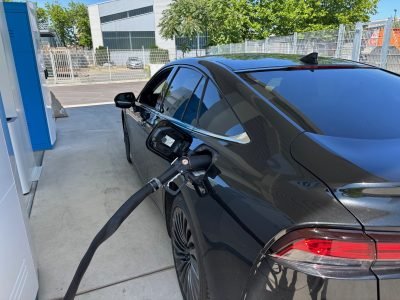 The facility combines three pressures (350/500/700 bar) in a single island, with high-performance technology that maintains flow and pressure for three simultaneous refuelings —buses, trucks, cars, and light commercial vehicles. In operational terms, this means more shifts covered, fewer queues, and a station built for the “shovel-and-pick” rhythm of fleets, not just for private cars.
Rheinbahn already operates 20 hydrogen buses and considers this station —just minutes from the Lierenfeld depot— as critical infrastructure to guarantee routes and availability. Meanwhile, the German market is shifting: in March 2025, sales at 350 bar surpassed those at 700 bar for the first time in the H2 MOBILITY network, a sign of the swing toward commercial vehicles. This same strategy explains the consolidation of 22 smaller 700 bar stations focused on passenger cars, while high-performance hubs like Düsseldorf are opening.
Why 500 bar matters
On site, Knitter’s explanation was straightforward: 500 bar enables refueling of 40–45 kg in 20–25 minutes, allowing vehicles to quickly get back on the road. Attempting the same mass at 700 bar drives up the size (and cost) of compressors and storage banks, making each kilo of H₂ more expensive. That’s why 500 bar has been introduced as an intermediate solution for utility fleets and future applications requiring more kilograms per session, without “paying” the complexity of 700 bar.
Interview with Daniel Knitter (extracts)
Mr. Knitter, what hard facts justify calling this the most powerful station in Europe?
The capacity of up to 5 tons per day and the ability to refuel three vehicles simultaneously (350/500/700 bar). It’s a scale leap compared to the country’s first-generation stations.
What does 500 bar provide that 350 or 700 bars don’t?
Cost-efficiency and operating pace. At 500 bars, we can deliver 40–45 kg in 20–25 minutes, ideal for utility vehicles and fleets needing more mass per session without the complexity of 700 bar. 350 bar is for buses and trucks: 700 bar suits cars and light commercial vehicles.
How is this level of performance sustained throughout the day?
Through intermediate storage and modular architecture. The operation includes tanks of ~1.2 t and two tanks in cycle to restock the station and get close to the daily maximum when demand requires it. The real key, however, is high-performance compression and the simultaneous management of pressures.
And what about regulation? Is it approved like any other station?
Yes. You can’t “set up” an HRS without permits. There are clear licenses and requirements (fire protection, process safety, metrology). “It’s well regulated; it’s not something in progress, it already exists,” we were told during the visit.
During the visit, the visible price for 350 bar was €15.5/kg (as shown in the operator’s app on that day; may vary by contract and pressure).
H2 MOBILITY’s pivot toward fleets —with 350 bar sales already surpassing 700 bar— and the launch of high-capacity hubs like Düsseldorf explain the redesign of its network in 2025. The project, funded under NIP2 and coordinated by NOW GmbH, also links production, distribution, and consumption in a low-emission urban loop: RFNBO today, a 2 MW electrolyzer from 2026 powered by waste energy. A blueprint that, more than a promise, is already operating at the pace of buses and trucks.
H2NEWS

