


China acelera su estrategia en el transporte marítimo sostenible con el lanzamiento del sistema de certificación GSTC
China acelera su estrategia en el transporte marítimo sostenible con el lanzamiento del sistema de certificación GSTC
H2NEWS
Fecha publicada: 10 Agosto, 2026
(English Below)
El combustible marino verde ya no es únicamente una cuestión de capacidad de producción o de suministro de bunkering. Cada vez más, se trata de un desafío de certificación. Mientras el Marco de Cero Emisiones Netas de la OMI continúa dejando detalles clave sin resolver —incluyendo la contabilidad de gases de efecto invernadero a lo largo del ciclo de vida, la certificación de combustibles, las reglas de cadena de custodia y el tratamiento de los atributos ecológicos—, el mercado internacional ha dependido en gran medida de esquemas como ISCC y RSB.
En este contexto, China está acelerando la creación de su propia capacidad de certificación. El pasado 30 de junio se celebró en Shanghái la Conferencia de Desarrollo Sostenible de Combustibles Verdes para el Transporte Marítimo Internacional de Shanghái. El evento fue organizado conjuntamente por Shanghai Exchange Group y SIPG, y presentado por Shanghai Shipping Exchange y SIPG Energy.
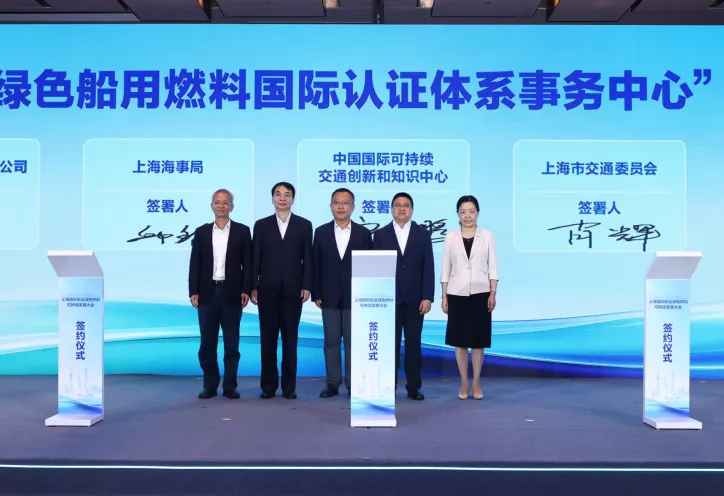
Uno de los resultados más relevantes fue la puesta en marcha del Green Marine Fuel International Certification System Affairs Center (GSTC) en Shanghái, junto con el inicio de operaciones oficiales del sistema GSTC, un modelo de certificación de combustible marino verde desarrollado de forma independiente por China.
Para el sector de los combustibles marinos verdes en China, el sistema GSTC se posiciona al lado de esquemas internacionales consolidados como ISCC y RSB. Su importancia no radica solo en la creación de una nueva entidad, sino en que demuestra la intención de China de avanzar desde la producción y el suministro hacia la capa más compleja de la certificación, la contabilidad y la alineación con las reglas internacionales.
Según la información presentada en la conferencia, el centro fue establecido conjuntamente por el Centro Internacional de Conocimiento e Innovación para el Transporte Sostenible de China, la Comisión Municipal de Transporte de Shanghái, la Administración de Seguridad Marítima de Shanghái, el Gobierno del Distrito de Hongkou y Shanghai Exchange Group. Esto le otorga al sistema un respaldo institucional claro. La presentación en Shanghái indica que el trabajo desarrollado durante los últimos años por diversas instituciones marítimas y de normalización está pasando de la discusión técnica a la implementación operativa.
Un marco operativo en evolución
El marco GSTC abarca actualmente varios módulos centrales. En el nivel superior incluye una carta de gobernanza y principios de sostenibilidad. En el ámbito de la sostenibilidad, el marco cubre diversas vías de materias primas y energía, como biomasa agrícola y forestal, residuos y deshechos, electricidad sostenible y fuentes de carbono, cambio directo del uso del suelo, materiales de bajo riesgo de cambio indirecto del uso del suelo y residuos generados durante la producción.
Asimismo, incluye requisitos de trazabilidad y cadena de custodia, metodología de cálculo de emisiones de gases de efecto invernadero en el ciclo de vida y procedimientos de gestión para organismos de certificación, auditores, operadores de la cadena de suministro, gestión de riesgos, resolución de disputas, supervisión, etiquetado y certificados.
Algunas secciones aún están marcadas para una futura ampliación. El GSTC no debe considerarse un estándar global terminado de la noche a la mañana, sino una arquitectura de certificación que ha entrado en fase operativa y cuyas normas detalladas se irán perfeccionando con el tiempo.
El momento del lanzamiento resulta clave. Bajo las futuras regulaciones de la OMI, el valor de un combustible marino verde no dependerá solo de si es metanol, amoníaco, hidrógeno, biocombustible o e-fuel, sino de si se puede verificar su intensidad de carbono, si sus materias primas son aceptadas, si sus emisiones del ciclo de vida se calculan mediante un método reconocido y si su certificado genera confianza en armadores, fletadores, puertos, reguladores, aseguradoras y entidades financieras. Sin certificación, el combustible verde es solo un producto físico; con certificación, se convierte en un instrumento de cumplimiento negociable.
Por ello, el lanzamiento del GSTC proporciona a China una base potencial para futuras discusiones en la OMI, el comercio internacional de combustibles verdes y el desarrollo de su mercado interno.
Plataforma de comercio y corredores logísticos
Otro resultado destacado de la conferencia fue la firma de un acuerdo para construir conjuntamente la Plataforma Internacional de Comercio de Combustibles Verdes para el Transporte Marítimo de Shanghái. La plataforma será desarrollada por la Bolsa de Envíos de Shanghái, la Bolsa de Medio Ambiente y Energía de Shanghái y CHN Energy Hydrogen Technology.
Está diseñada para pilotar un proceso de circuito cerrado que abarca la confirmación de la certificación del combustible verde, el registro, la negociación, la liquidación y la cancelación. A largo plazo, esto podría respaldar la formación de un “precio de Shanghái” para los combustibles marinos verdes, especialmente si la oferta física, la certificación y la infraestructura comercial logran conectarse eficazmente.
Un tercer avance significativo fue la formación de una cadena de suministro de metanol verde interregional. Shanghái, Jilin y Liaoning trabajan conjuntamente en el corredor denominado “Metanol del Norte hacia el Sur”. La cadena propuesta conecta la producción de metanol verde en Taonan (Jilin) con el almacenamiento y transbordo a través del Puerto de Dalian, culminando en el suministro final en el Puerto de Shanghái.
Más que un acuerdo logístico, esta iniciativa conecta la capacidad de producción del interior y norte de China con uno de los puertos de bunkering internacional más grandes del mundo. Si logra escalar, puede convertirse en un modelo importante para mover el metanol verde chino hacia la demanda marítima global.
En el ámbito del suministro, Shanghái ha desarrollado capacidades paralelas para el bunkering de GNL y metanol verde, y durante la conferencia lanzó un plan de acción al 2030 para expandir esta capacidad.
En la sesión de certificación, cinco empresas se convirtieron en los primeros participantes del mercado certificados bajo el sistema GSTC: China Energy Engineering Group, Hong Kong and China Gas, Shenergy Group, SIPG Energy y Shanghai Huayi Holdings. Envision Energy y otras compañías también firmaron acuerdos de intención de certificación.
Hacia un sistema integral de servicios verdes
En conjunto, estos movimientos muestran una dirección clara: Shanghái no solo busca ser un centro de suministro de combustible verde, sino construir un sistema completo de servicios que abarque certificación, comercio y bunkering. Para China, representa un paso para pasar de ser un participante del mercado a ayudar a configurar su infraestructura.
El desafío actual reside en la aceptación internacional. Para que el GSTC alcance una influencia real, necesitará una verificación de terceros creíble, una metodología de ciclo de vida transparente, compatibilidad con las normas de la OMI y cierto grado de interoperabilidad con los esquemas de certificación internacionales existentes, además del reconocimiento de armadores, fletadores, empresas energéticas e instituciones financieras.
A medida que el transporte marítimo verde entra en la era del cumplimiento normativo y la contabilidad ambiental, la competencia ya no se limita a quién puede producir combustible verde, sino a quién puede certificarlo, fijar su precio, comerciarlo y entregarlo a los buques. El lanzamiento del GSTC indica que China tiene la intención de asumir un rol activo en los cuatro ámbitos.
English Version
Green marine fuel is no longer only a question of production capacity or bunkering capability. Increasingly, it is a question of certification. As the IMO Net-Zero Framework continues to leave key details unresolved—including lifecycle greenhouse gas accounting, fuel certification, chain-of-custody rules, and the treatment of green fuel attributes—the international market has largely relied on certification schemes such as ISCC and RSB. In this context, China is accelerating the build-out of its own certification capacity.
On June 30, the Shanghai International Shipping Green Fuel Sustainable Development Conference was held in Shanghai. The event was jointly organized by Shanghai Exchange Group and SIPG, and hosted by the Shanghai Shipping Exchange and SIPG Energy.
One of the most important outcomes was the launch of the Green Marine Fuel International Certification System Affairs Center in Shanghai, together with the official operation of China’s independently developed GSTC Green Marine Fuel Certification System.
For China’s green marine fuel sector, the GSTC framework can be understood as a certification system positioned alongside established international schemes such as ISCC and RSB. Its significance lies not merely in the creation of another organization, but in demonstrating China’s intent to move from green fuel production and bunkering to the more complex layer of certification, accounting, and international rule alignment.
According to information presented at the conference, the center was jointly established by the China International Sustainable Transport Innovation and Knowledge Center, the Shanghai Municipal Transportation Commission, the Shanghai Maritime Safety Administration, the Hongkou District Government, and Shanghai Exchange Group. This gives the system a clear institutional backing. The launch in Shanghai indicates that work carried out over recent years by various maritime, energy, and standards-related institutions is moving from technical discussion into operational implementation.
An Evolving Operational Framework
The GSTC framework currently covers several core modules. At the top level, it includes a governance charter and sustainability principles. Under the sustainability section, the framework covers various feedstock and energy pathways, including agricultural and forestry biomass, waste and residues, sustainable electricity and carbon sources, direct land-use change, low indirect land-use-change risk materials, and waste generated during production.
Additionally, it includes traceability and chain-of-custody requirements, lifecycle greenhouse gas emission calculation methodologies, and management procedures for certification bodies, auditors, supply-chain operators, risk management, dispute resolution, supervision, labeling, and certificates.
Some sections are still marked for future expansion. GSTC should not be seen as a finished global standard overnight, but rather as a certification architecture that has entered an operational phase, with detailed standards expected to be refined over time.
The timing of the launch is crucial. Under future IMO regulations, the value of a green marine fuel will depend not only on whether it is methanol, ammonia, hydrogen, biofuel, or e-fuel, but on whether its carbon intensity can be verified, whether its feedstocks are accepted, whether its lifecycle emissions are calculated using a recognized method, and whether its certificate earns the trust of shipowners, charterers, ports, regulators, insurers, and financial institutions. Without certification, green fuel is merely a physical product; with certification, it becomes a tradable compliance instrument.
Therefore, the launch of GSTC provides China with a potential foundation for future IMO discussions, international green fuel trade, and domestic market development.
Trading Platforms and Logistics Corridors
Another major outcome of the conference was the signing of an agreement to jointly build the Shanghai International Shipping Green Fuel Trading Platform. The platform will be developed by the Shanghai Shipping Exchange, Shanghai Environment and Energy Exchange, and CHN Energy Hydrogen Technology.
It is designed to pilot a closed-loop process covering green fuel certification confirmation, registration, trading, settlement, and cancellation. In the longer term, this could support the formation of a ‘Shanghai price’ for green marine fuels, especially if physical supply, certification, and trading infrastructure are effectively connected.
A third key development was the formation of a cross-regional green methanol supply chain. Shanghai, Jilin, and Liaoning are working together on a corridor dubbed ‘North Methanol Southbound.’ The proposed chain links green methanol production in Taonan (Jilin) with storage and transshipment through Dalian Port, culminating in final bunkering at Shanghai Port.
More than just a logistics arrangement, this initiative connects inland and northern China’s production capacity with one of the world’s largest international bunkering ports. If scaled up, it could become an important model for moving Chinese green methanol toward global shipping demand.
On the bunkering side, Shanghai has developed parallel capabilities for LNG and green methanol bunkering, and during the conference launched a 2030 action plan to expand this capacity.
In the certification session, five companies became the first market participants certified under the GSTC system: China Energy Engineering Group, Hong Kong and China Gas, Shenergy Group, SIPG Energy, and Shanghai Huayi Holdings. Envision Energy and several other companies also signed certification intention agreements.
Toward a Full Green Services System
Taken together, these moves show a clear direction: Shanghai is not only trying to become a green fuel bunkering center, but is building a comprehensive service system covering certification, trading, and bunkering. For China, this represents a step from participating in the green fuel market to helping shape its infrastructure.
The current challenge lies in international acceptance. For GSTC to gain true influence, it will require credible third-party verification, a transparent lifecycle methodology, compatibility with IMO rules, and a degree of interoperability with existing international certification schemes, alongside recognition from shipowners, charterers, energy companies, and financial institutions.
As green shipping enters the compliance and accounting era, competition is no longer just about who can produce green fuel, but about who can certify, price, trade, and deliver it to ships. The launch of GSTC indicates that China intends to play an active role in all four areas.
Traducción: AI
Edición: H2News

